"I had the opportunity to work with David while leading CooperVision Specialty EyeCare for the Americas, and he quickly became someone we relied on during major integrations and large-scope initiatives. David has two standout strengths: operational clarity — he understands processes intuitively and can immediately identify where waste, delays, or unnecessary complexity exist — and project leadership. He knows when it’s time to gather input and when it’s time to call for a decision, which is an essential skill in a large organization. David brings insight, efficiency, and action to every project he touches. I would work with him again without hesitation — and others should, too."
Our Services
Workflow Diagnostics.
Structured Improvement.
Measurable Impact.
Vendor-neutral workflow diagnostics, stabilization, and execution-ready roadmaps designed to improve operational clarity without disrupting what already works.
The bottleneck usually isn’t the people. It’s the workflow.
Led by an operations practitioner with 25+ years improving workflows across manufacturing, distribution, and service organizations.
Not All Operations Consulting Starts in the Same Place
Companies experiencing operational friction often assume they need “operations consulting.” In reality, there are several different approaches to solving operational problems — and each begins at a different level.
Many firms focus on organizational structure or efficiency programs. Those can be valuable, but they often assume the underlying workflow problems are already understood.
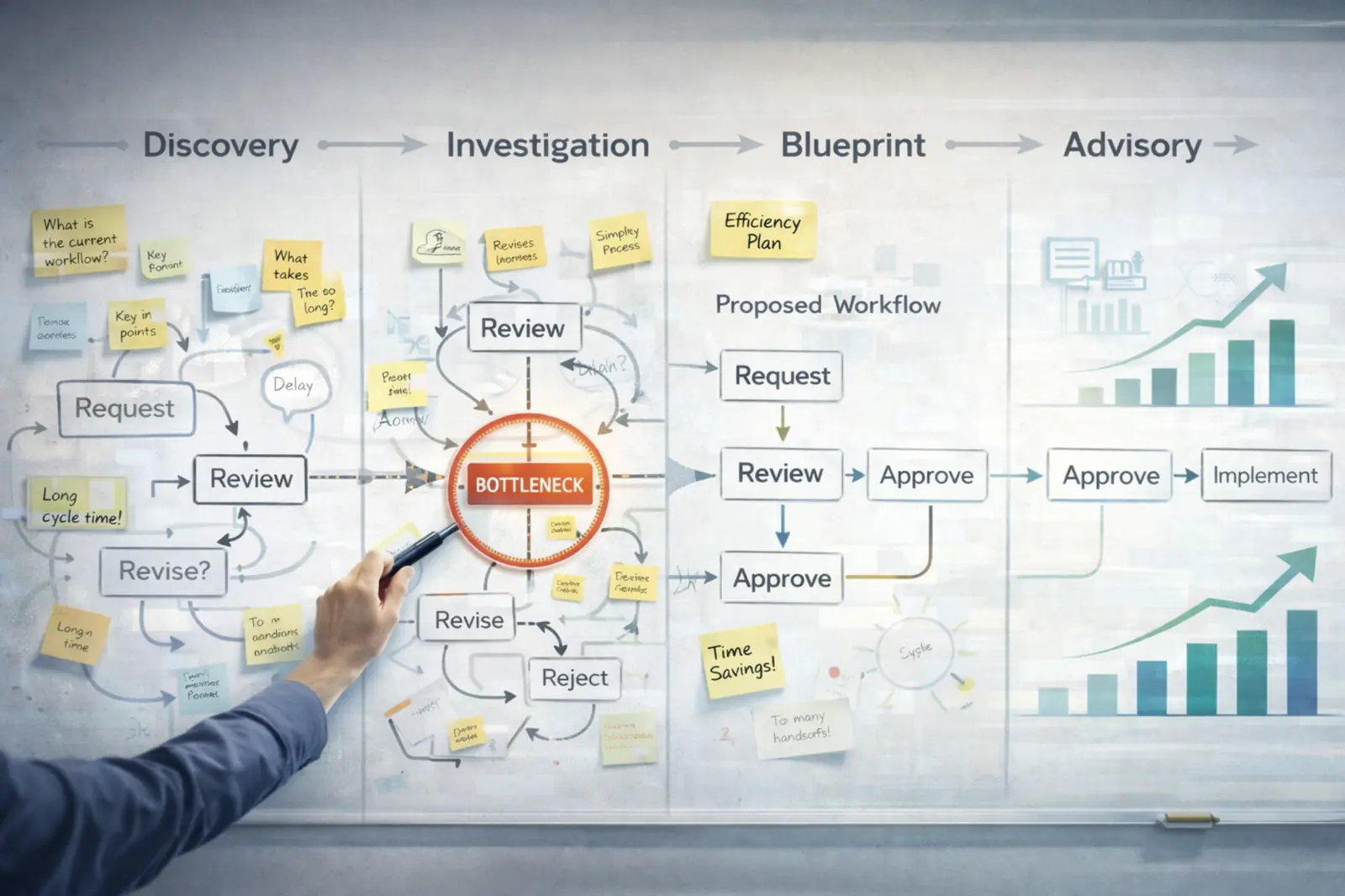
DECG starts earlier. Before recommending new systems, new roles, or new processes, we diagnose how work actually flows through the organization. That means examining handoffs, identifying bottlenecks, and uncovering where tasks slow down, repeat, or disappear. Learn how the DECG diagnostic process works →
This diagnostic approach provides clarity before companies invest in major operational changes.
Different Approaches to Operations Consulting
| Consulting Approach | Primary Focus |
|---|---|
| Organizational Strategy | Structure, leadership roles, operating models |
| Lean / Efficiency Consulting | Cost reduction and throughput improvement |
| Independent Operators | Industry expertise and leadership guidance |
| DECG – Workflow Diagnostics | Understanding how work actually flows across teams, systems, and processes |
Once the workflow is clearly understood, companies can make smarter decisions about process improvements, technology investments, and operational structure.
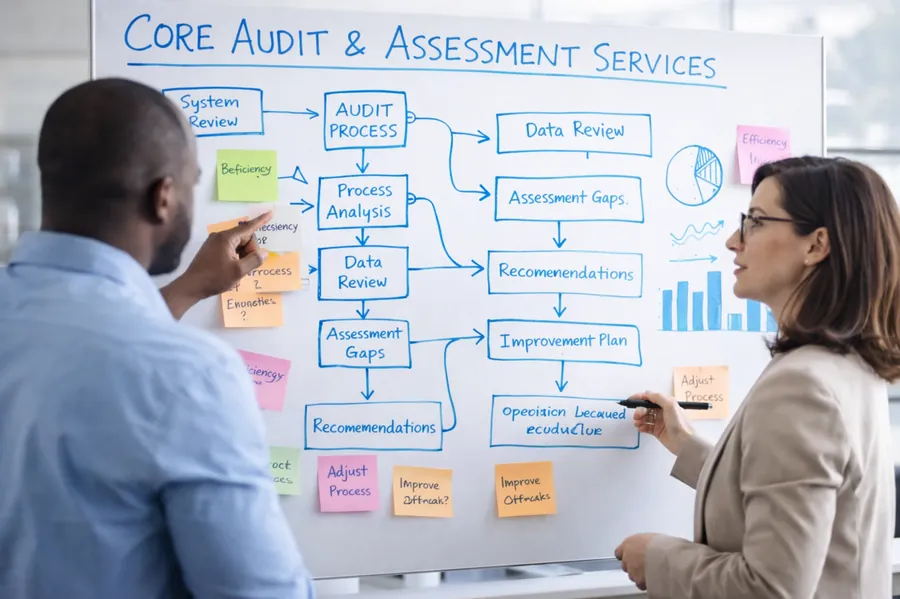
Core Workflow Diagnostics & Assessment Services
Technical Ecosystem Audit
Comprehensive review of software stack, licensing, permissions, integrations, reporting structures, and documentation integrity.
Customer Experience (CX) Audit
End-to-end evaluation of the customer journey to uncover friction, delays, communication gaps, and hidden cost drivers.
Single Process Audit
Focused workflow diagnostic of one critical process to identify bottlenecks, redundancy, handoff issues, and improvement opportunities.
Operational Efficiency Audit
Comprehensive workflow diagnostic across departments to identify bottlenecks, improve alignment, and restore operational visibility.
Vendor & Platform Evaluation
Vendor-neutral analysis of tools, contracts, and usage to ensure you’re paying for value, not shelfware.
Read the full case study →
Workflow Stabilization & Process Development
Process Mapping & Documentation
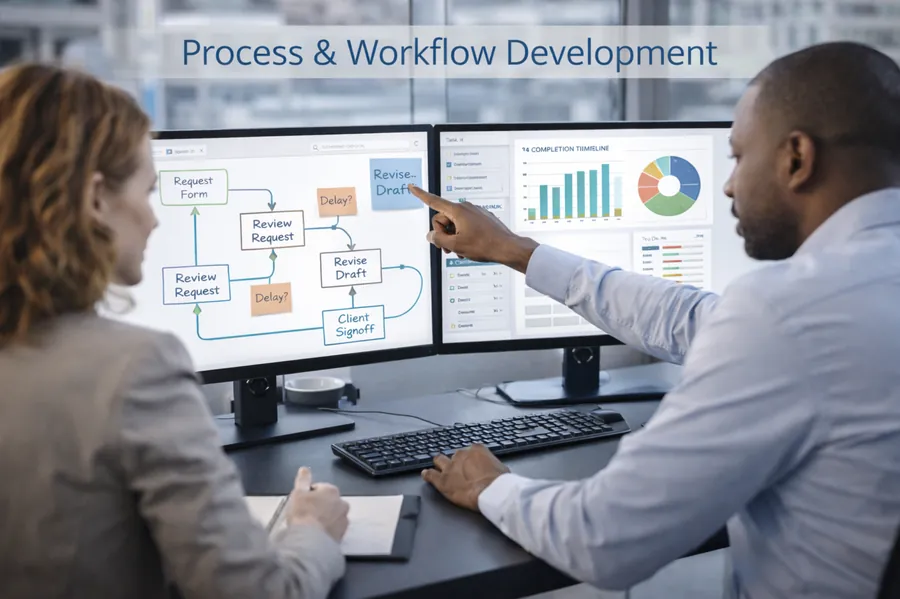
Clear visual workflow mapping with defined ownership, inputs, outputs, and decision points.
SOP Development & Cleanup
Standard Operating Procedure creation, restructuring, and clarity refinement to reduce tribal knowledge.
Workflow Redesign
Redesigning inefficient workflows based on diagnostic findings to create stable, measurable systems without disrupting existing operations.
Bottleneck Identification & Resolution Planning
Pinpointing manufacturing process bottlenecks and efficiency constraints and building execution-ready solutions.
Example outcome: A manufacturing operation replaced paper-based QA checks with digital checkpoints and tray scanning, eliminating manual paperwork and saving hundreds of labor hours each year.
Collaboration & Organizational Alignment
Cross-Department Collaboration Development
Improving communication structure, meeting flow, ownership clarity, and decision alignment.
Role & Responsibility Clarification
Reducing overlap and confusion through structured accountability frameworks.
Leadership Workflow Coaching
Helping team leads and managers create stability before pursuing growth initiatives.
Example outcome: An optical distribution company reduced packing errors and increased daily order throughput by 7% while lowering cost per order after redesigning key fulfillment workflows.
Strategic Improvements & Execution Planning
Execution Roadmap Development
Phased improvement plans designed for practical implementation, not PowerPoint shelf decoration.
Cost Containment & Waste Reduction Strategy
Identifying operational and technical inefficiencies that impact margins.
Documentation & Audit Log Review
Ensuring systems, permissions, and reporting structures are compliant and understandable.
How DECG Engagements Typically Work
Many consulting firms begin engagements with large operational transformation projects or organizational restructuring. Those approaches can be valuable, but they often require significant financial commitment before the real workflow constraints are fully understood.
DECG takes a different approach. Engagements are structured in phases so organizations can first identify where operational friction actually exists, review the findings, and then decide whether deeper improvement work is justified. See the full DECG process →
This phased structure allows leadership to make informed decisions at each step rather than committing to large consulting engagements before the underlying workflow issues are clearly understood.
Phase 1 — Complimentary Discovery Meeting
Investment: No cost
A short introductory conversation to understand the workflow, the challenges the organization is experiencing, and whether a deeper diagnostic investigation would be useful.
The goal is simple: determine whether a Diagnostic Investigation would provide meaningful value before any paid work begins.
If the situation sounds familiar, a short discovery conversation is the easiest way to determine whether a Diagnostic Investigation would be useful.
Schedule a Discovery Call →Phase 2 — Diagnostic Investigation
Typical investment: $1,500 – $5,000
This phase is a structured operational investigation designed to determine whether meaningful workflow inefficiencies or process breakdowns exist.
DECG conducts targeted interviews, workflow walkthroughs, and operational observations to understand how the process actually functions in practice.
- The workflow as it currently operates
- The areas examined during the investigation
- Operational issues or inefficiencies identified
This phase does not include solutions or implementation planning. Its purpose is to provide leadership with clear operational facts before deciding whether deeper improvement work is warranted.
Phase 3 — Efficiency Blueprint Development
Investment: Scoped based on workflow complexity
If the Diagnostic Investigation confirms meaningful opportunities for improvement, DECG develops a detailed Efficiency Blueprint.
This work translates investigation findings into a structured operational roadmap leadership can use to guide improvements.
From experience, a typical single-workflow engagement requires approximately 60–70 hours of analysis and blueprint development, depending on workflow complexity and operational variables involved.
The blueprint provides prioritized recommendations, workflow redesign guidance, impact estimates, and a phased sequence for implementation.
Phase 4 — Implementation Advisory
Investment: Hour blocks purchased as needed
As organizations begin implementing improvements, operational questions and adjustments often arise.
DECG provides advisory support through pre-purchased consulting hour blocks. Advisory work is typically billed at $225 per hour.
This allows leadership teams to validate implementation decisions, adjust improvement plans, and resolve workflow questions as operational changes are executed.
Leaders we’ve worked with, in their own words
A sample of the feedback David and Digital Efficiency Consulting Group receive from partners, clients, and industry leaders.
"If you're looking to partner with someone who sees opportunities before most others do, David is the person to call. Long before strategic alliances became common in our industry, David approached us with a forward-thinking idea that ultimately created meaningful value for both of our organizations. His ability to recognize how the business environment was evolving, combined with a practical approach to building partnerships that benefit everyone involved, made the collaboration extremely successful. When challenges came up, David’s depth of knowledge and clear direction helped keep the work moving forward and focused on the right outcomes. David brings a rare mix of strategic thinking and real-world operational understanding. Organizations that work with him through DECG can expect thoughtful collaboration, smart ideas, and a partner who genuinely wants to help their business succeed."
How our services work in practice.
These answers explain how engagements are structured, how we approach workflow diagnostics, and what you can expect as we identify and improve operational inefficiencies.
What are workflow diagnostics?
Workflow diagnostics is the process of examining how work actually moves through an organization to identify operational bottlenecks, inefficient handoffs, unnecessary approvals, and data breakdowns that slow execution.
Rather than focusing only on high-level strategy, workflow diagnostics analyzes the real day-to-day workflows teams use to complete work. The goal is to uncover where time is lost, where work becomes stuck, and which practical changes will improve efficiency without creating unnecessary disruption.
If you want to see how this approach works in practice, explore our Workflow Diagnostics Services or review the Efficiency Roadmap that guides most engagements.
What is DECG, in plain English?
Digital Efficiency Consulting Group (DECG) is an advisory firm that finds the hidden “time leaks” that create rework, delays, and decision fog. We map how work actually moves across teams, pinpoint where it breaks, and turn that into a clear, prioritized plan (see our workflow diagnostics audit for details).
If you want the quick “how we work” version, jump to our Efficiency Roadmap section. If you want the high-level overview first, start at About DECG.
What kind of companies is DECG a strong fit for?
DECG is a strong fit for organizations with real operations: handoffs between teams, exception handling, compliance constraints, and leadership reporting that has to be right. If you have capable people but work still gets “stuck” in the cracks, that’s our favorite kind of puzzle.
For the most common engagement types (and where you’d likely start), see Services. If you’re unsure, the Contact section is the easiest next step.
Do you push software or specific vendors?
No. DECG does not sell software, receive vendor kickbacks, or design projects to steer you into a purchase. If a tool helps, we will say so. If it doesn’t, we will say that too.
This is core to how we work. The details are spelled out on the Neutrality page.
What is ongoing advisory (retainer) support, and how does it work?
Ongoing advisory (retainer) support is for teams that want a steady, lightweight partner to keep improvements moving: quick diagnostics, decision support, and “are we about to do something dumb?” review before you commit time and budget.
It’s a good fit after an initial roadmap or when you’re managing multiple improvements over time. See Services, or start a conversation via Contact.